Research
Snow Pool
To communicate avalanche safety information in a way that works for you, we need your help.
Overview
CAIC teamed up with the Avalanche Research Program (opens in a new tab) of Simon Fraser University in Canada, the U.S. National Science Foundation National Center for Atmospheric Research (opens in a new tab) (NSF NCAR), and the Friends of CAIC (opens in a new tab) on a collaborative research project to improve avalanche safety communications.
Research Findings
A big thank you to everyone who participated in the forecast survey last season. Your input contributed to the paper “Users’ Awareness and Response to Uncertainty Information in Public Avalanche Forecasts” (opens in a new tab) by Eeva Latosuo, Pascal Haegeli, Julie Demuth, and Ethan Greene.
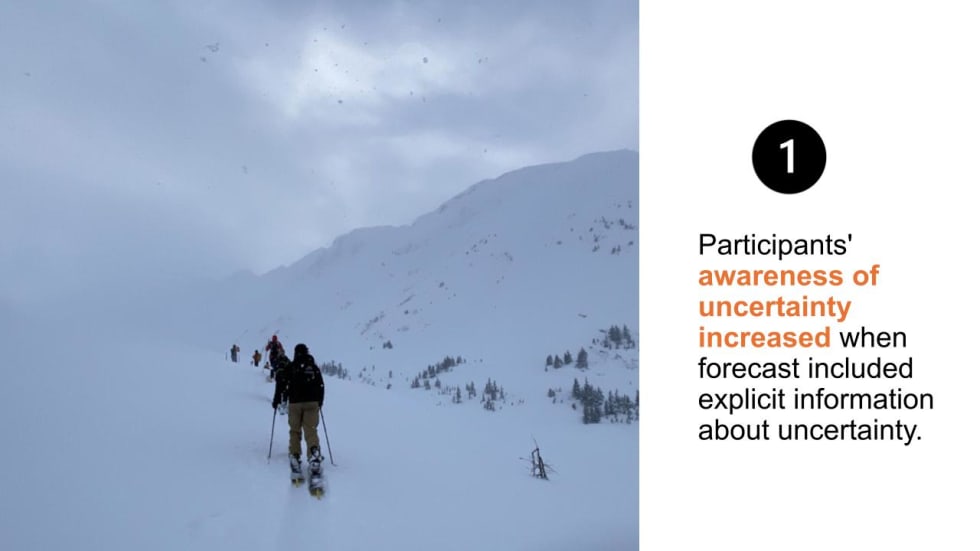
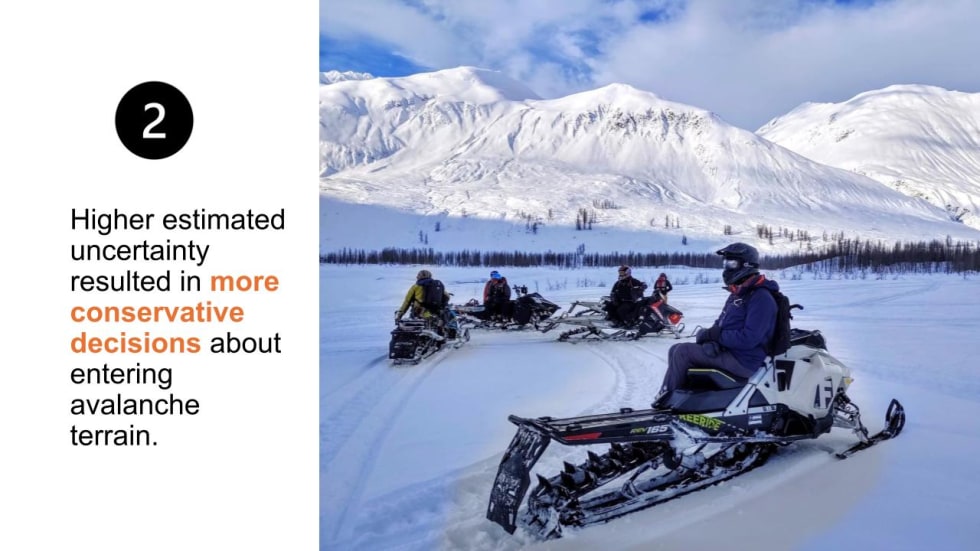
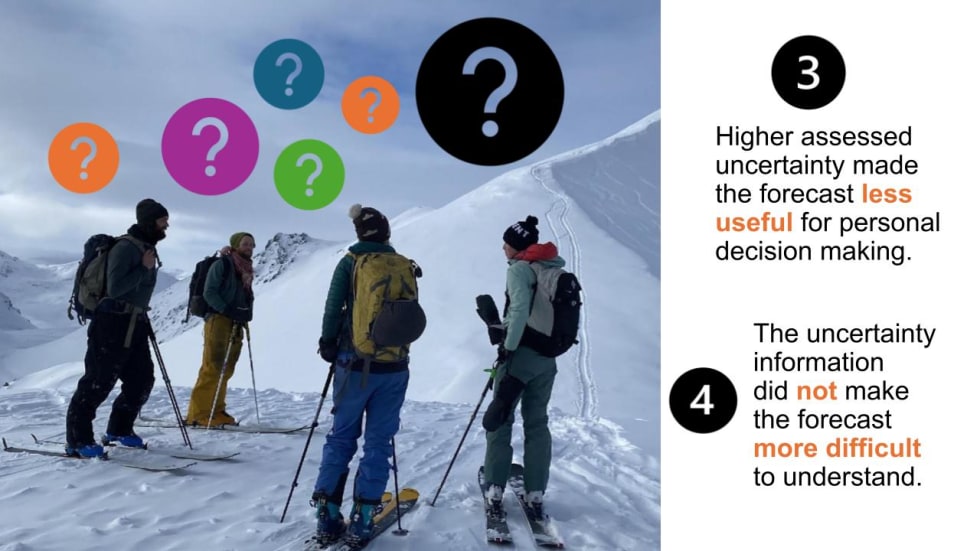
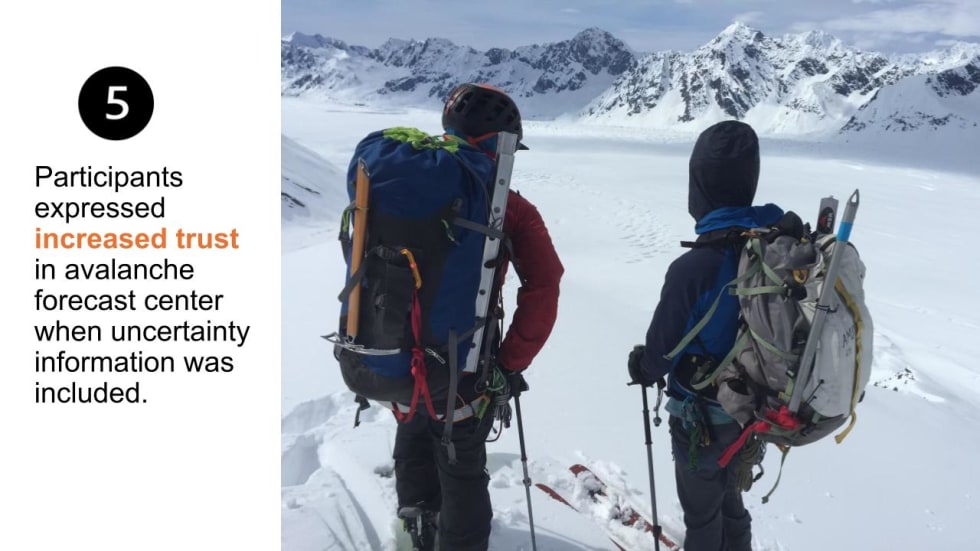
This study explored how backcountry users perceive and respond to uncertainty in avalanche forecasts. By analyzing responses from 1,313 participants, the research revealed that clearly communicating uncertainty significantly impacts decision-making and fosters trust in forecast centers.
Your participation provided valuable insights that will help improve how avalanche risks are communicated, making the backcountry safer for everyone. Thank you for being part of this important work.
From the 2024 Colorado Snow and Avalanche Workshop
A few slides from Eeva’s presentation on this research. You can watch the full presentation (opens in a new tab).
You Can Still Join
People can still sign up to take part next season, so encourage your friends to join. The CAIC needs people from all walks of life in the Snow Pool:
- With and without avalanche training
- All travel modes
- Living in all parts of Colorado
- Travelling to Colorado for recreation
Everyone who signs up receives regular emails from the CAIC inviting them to online user surveys, and the chance to give feedback on CAIC products and priorities. It is an opportunity to:
- Be part of a community contributing to better avalanche risk communication
- Learn about CAIC research projects
- Be eligible for prizes
Research Team
Eeva Latosuo, PhD Student and Research Lead (SFU)
Originally from Finland, my Master’s degree is in Environmental Science from the University of Helsinki. My outdoor career started as a climbing instructor for National Outdoor Leadership School and a professional ski patroller in Colorado — a special shout out to Vail Ski Patrol. For the last 18 years I have been an associate professor of Outdoor Studies at Alaska Pacific University, delivering courses and field intensives in snow science and technical climbing. I continue to teach professional avalanche courses in the U.S. I am also an active member of the Search and Rescue community, including as an avalanche dog handler and an avalanche specialist.
Ever since spending time in the North Cascades in the mid-90s, I have been drawn to the mountain environment and the people interacting with this landscape. How do we draw joy from the mountains, and how do we navigate their complex risks? I get excited geeking out about the snowpack, but what really motivates me is observing what us humans do with the medium. That curiosity landed me in the Avalanche Risk Communication research group at Simon Fraser University as a PhD student.
My role in this project is lead researcher, under the guidance of Pascal Haegeli from SFU and Julie Demuth from the National Center for Atmospheric Research. Using a transdisciplinary approach and applying social science frameworks, I focus on the user’s perspective on what works and what doesn’t in avalanche risk communication. Learning from the people who use the services helps avalanche professionals improve the quality of their forecasting products.
Pascal Haegeli, Associate Professor and Supervisor (SFU)
I found my love for the mountains, snow and skiing in my childhood in Switzerland where I was born and raised, but it was only during my early years at university that I started to ski in the backcountry. I had the fortune to have a few knowledgeable friends who introduced me to the craft of reading the avalanche bulletin, setting a track, and using a transceiver.
In 1998 I moved to British Columbia to pursue a PhD at the University of British Columbia focusing on avalanches, which let me combine my interest in science with my passion for the winter backcountry. Over the last 23 years I have been fortunate to work with many people who shared their avalanche experience, knowledge and wisdom, and lucky to find a way to contribute to the Canadian avalanche community with my academic skills. Since 2015 I have had the pleasure of working with a wonderful team of students exploring avalanche safety research at Simon Fraser University.
My role in this project is to assist Eeva and guide her research approach in the background, to ensure we make the most of her enthusiasm and research talent.
Julie Demuth, Scientist (NSF NCAR)
Julie Demuth is a research scientist at the U.S. National Science Foundation National Center for Atmospheric Research (NSF NCAR), in the Mesoscale and Microscale Meteorology Lab with the Weather Risks and Decisions in Society research group. She has worked for more than 15 years on integrating social science research with the meteorological research and practitioner communities.
With a hybrid background in atmospheric science and communication, Julie researches hazardous weather risk communication, risk perception and response, working with both experts such as weather forecasters and with members of the public. Her work centres on understanding how forecast information, alongside other factors, influences what people think and feel and how they respond.
Before NSF NCAR, Julie spent three years in Washington DC as a Program Officer at the National Academies of Sciences, Engineering, and Medicine for the Board on Atmospheric Sciences and Climate. She received her BS in meteorology from the University of Nebraska-Lincoln, her MS in atmospheric science from Colorado State University, and her PhD in public communication and technology from Colorado State University.