
Learn
Avalanche Problems
What an avalanche problem is
Avalanche Problem: A set of 4 factors (type, location, likelihood, size) whose combination describes the avalanche hazard.
- Avalanche Character or Type — One of 9 potential avalanche descriptions
- Location — Where it is most likely to exist, shown with an Aspect/Elevation diagram
- Likelihood — The chance of triggering an avalanche
- Size — The destructive potential of the expected avalanche


Release of dry unconsolidated snow. These avalanches typically occur within layers of soft snow near the surface of the snowpack. Loose-dry avalanches start at a point and entrain snow as they move downhill, forming a fan-shaped avalanche. Other names include point-release avalanches or sluffs.
Loose Dry avalanches are usually relatively harmless to people. They can be hazardous if you are caught and carried into or over a terrain trap (e.g. gully, rocks, dense timber, cliff). Avoid traveling in or above terrain traps when Loose Dry avalanches are likely.

Release of a soft cohesive layer (a slab) of new snow that breaks within the storm snow or on the old snow surface. Storm-slab problems typically last between a few hours and few days. Storm-slabs that form over a persistent weak layer may develop into Persistent Slabs.
You can reduce your risk by waiting a day or two after a storm. Storm slabs are most dangerous on slopes with terrain traps, such as timber, gullies, over cliffs, or terrain features that make it difficult for a rider to escape.

Release of a cohesive layer of snow (a slab) formed by the wind. Wind typically transports snow from the upwind sides of terrain features and deposits snow on the downwind side. Wind slabs are often smooth and rounded and sometimes sound hollow.
Wind Slabs form in specific areas and are confined to lee and cross-loaded terrain features. They can be avoided by sticking to sheltered or wind-scoured areas.

Release of a cohesive layer of soft to hard snow in the middle to upper snowpack when the bond to an underlying persistent weak layer breaks. Persistent layers include: surface hoar, depth hoar, near-surface facets, or faceted snow. These can continue to produce avalanches for days, weeks or even months.
The best way to manage risk is to make conservative terrain choices. They can be triggered by light loads weeks after the last storm. This problem requires a wide safety buffer to handle the uncertainty.

Release of a thick cohesive layer of hard snow deep in the snowpack or near the ground. They are typically hard to trigger, very destructive, and can persist for months. They commonly develop when Persistent Slabs become more deeply buried over time.
Deep Persistent Slabs are destructive and deadly. You can trigger them from well down in the avalanche path and after dozens of tracks have crossed the slope.
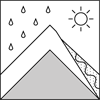
Release of wet unconsolidated snow or slush. These avalanches typically occur near the surface but may quickly gouge into lower snowpack layers. They generally move slowly but contain enough mass to cause significant damage to trees, cars or buildings.
Travel when the snow surface is colder and stronger. Move to colder, shadier slopes once the snow surface turns slushy. Avoid steep sunlit slopes above terrain traps and cliffs.

Release of a cohesive layer of snow when liquid water weakens the bond between the slab and the surface below. They often occur during prolonged warming events and/or rain-on-snow events and can be very destructive.
Avoid terrain where and when you suspect Wet Slab avalanche activity. Give yourself a wide safety buffer to handle the uncertainty.

Release of an overhanging mass of snow formed by wind. They can break off suddenly and pull back onto the ridge top, catching people by surprise even on flat ground above the slope. Even small cornices have enough mass to be deadly.
Cornices can never be trusted. Stay well back from ridge line areas and avoid areas underneath them. Significant temperature warm-ups are times to be particularly aware.
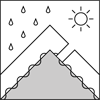
Release of the entire snow cover as a result of gliding over the ground. They are often preceded by full-depth 'glide cracks.' They are unlikely to be triggered by a person and are nearly impossible to forecast.
Safe travel relies on identifying and avoiding specific slopes where glide cracks are visible.